
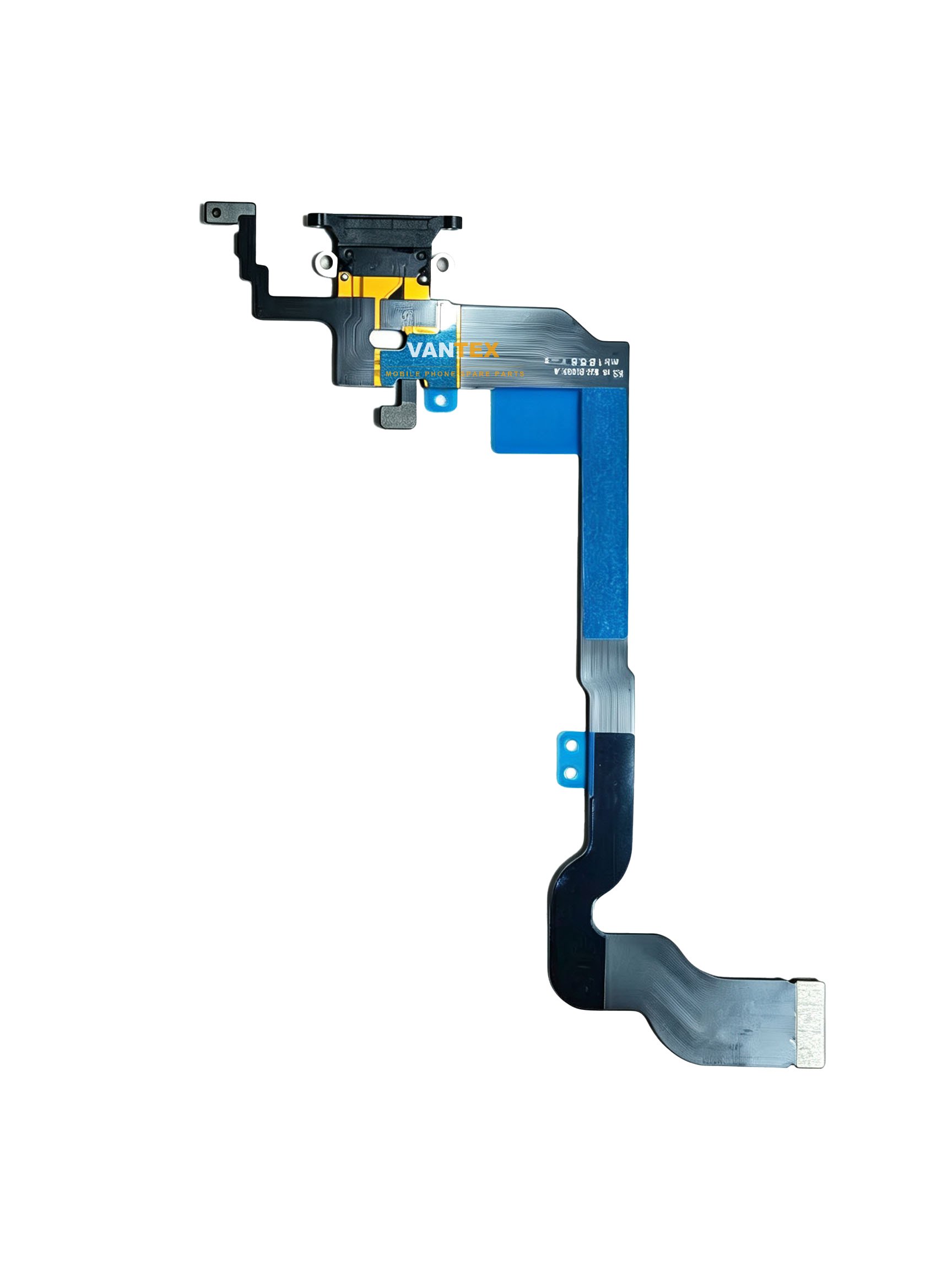
What is a charging board?
A charging board (also called a charge port flex or charging PCB) is the internal assembly that manages power delivery between a phone’s charging port, its battery, and the logic board. It carries the charging current, filters voltage spikes, and passes battery status data back to the operating system. In most modern phones the charging board is a small flex-PCB hybrid sitting at the bottom of the device, connected to the motherboard by one or two board-to-board connectors.
How does a charging board work?
When you plug in a cable, the charging board performs three jobs in sequence:
- Handshake - it negotiates the charging protocol (USB Power Delivery, QC, or a proprietary fast-charge scheme) with the adapter. USB-IF, the industry standards body, defines the compliance profiles most adapters follow.
- Conversion - the onboard IC steps the input voltage down or up to what the battery can safely accept, typically converting a 9V fast-charge input to battery-level voltage.
- Protection - it cuts the circuit on over-voltage, over-current or overheating, which is why a failed charging board usually fails “safe” (no charging at all) rather than damaging the battery.
5 signs the charging board is failing
Based on repair-shop fault reports, these symptoms account for the majority of charging-related repairs:
- No charging at all - the phone shows no charging icon on any cable or adapter.
- Intermittent charging - the icon appears and disappears when the cable is moved slightly.
- Charges only at an angle - a classic worn-port symptom caused by a loosened connector.
- Slow charging - the device charges but never negotiates fast-charge speeds.
- Accessory warnings - repeated “accessory not supported” pop-ups on genuine cables.
If the phone charges normally with a wireless pad but not by cable, the battery and motherboard are almost certainly fine - the charging board is the culprit.
Charging board vs power flex vs charging port: what is the difference?
Buyers often mix up three related parts. The charging port is the metal connector itself. The power flex carries power between the sub-boards of the phone. The charging board combines the port with its supporting ICs and flex in one replaceable assembly. Replacing the whole charging board instead of micro-soldering a single port saves an average of 20-40 minutes of bench time per repair, which is why wholesalers like Vantex stock it as a complete assembly.
OEM, original-surplus, and aftermarket: which should a repair shop buy?
- OEM parts come from the original manufacturer’s channel - highest cost, often restricted supply.
- Original-surplus / pulled parts are removed from donor phones - quality varies unit by unit.
- Aftermarket parts are independently manufactured. A tested aftermarket charging board from a supplier like Vantex typically costs 30-60% less than OEM and ships with batch QC reports covering charging current and connector fit.
For walk-in repairs where the customer wants the phone working today, a tested aftermarket charging board is the industry-standard choice.
Where to buy charging boards in bulk
Vantex supplies independent-aftermarket charging boards for iPhone, Samsung, Honor, Huawei, Xiaomi, Redmi, Infinix, Tecno, itel and Nokia models, with wholesale pricing for repair shops and distributors. Every batch is factory-tested for charging current, connector fit and flex durability before dispatch. Browse the charging board catalog or request batch pricing on the wholesale page.